
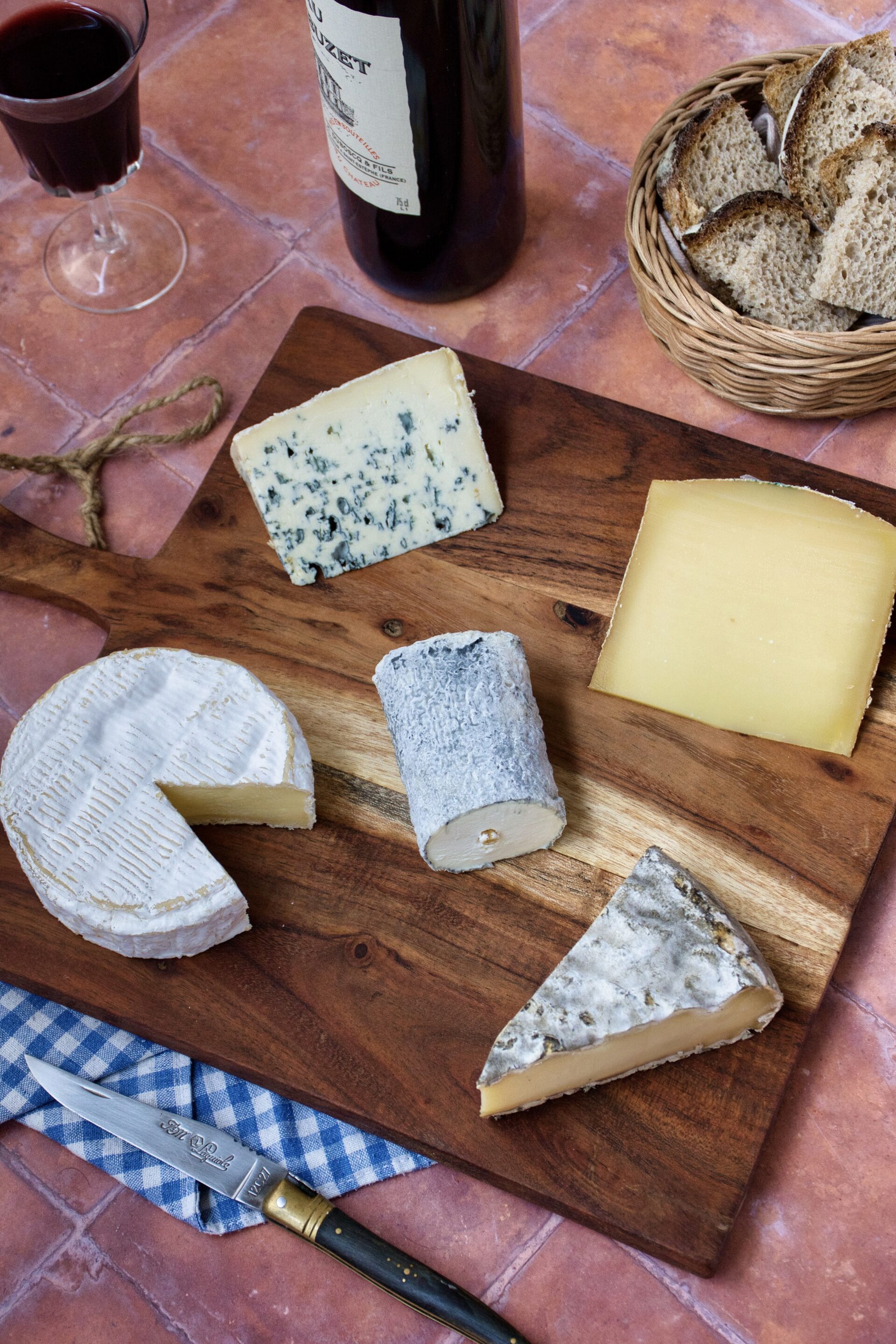
Comté, Saint-Nectaire, Sainte-Maure de Touraine, Camembert, and Fourme d’Ambert—these are five iconic French cheeses you should definitely know. In this guide, you’ll discover their origins, flavor profiles, ideal drink pairings, and ways to cook with them.
If you’ve missed it, I’m slowly but surely eating my way through France. Naturally, this means visiting plenty of fromageries (cheese shops). And now, thanks to my Ultimate Guide to French Cheese series, I’m taking you on this delicious journey with me, one cheese at a time!
Here are the cheeses I’ll be talking about today:
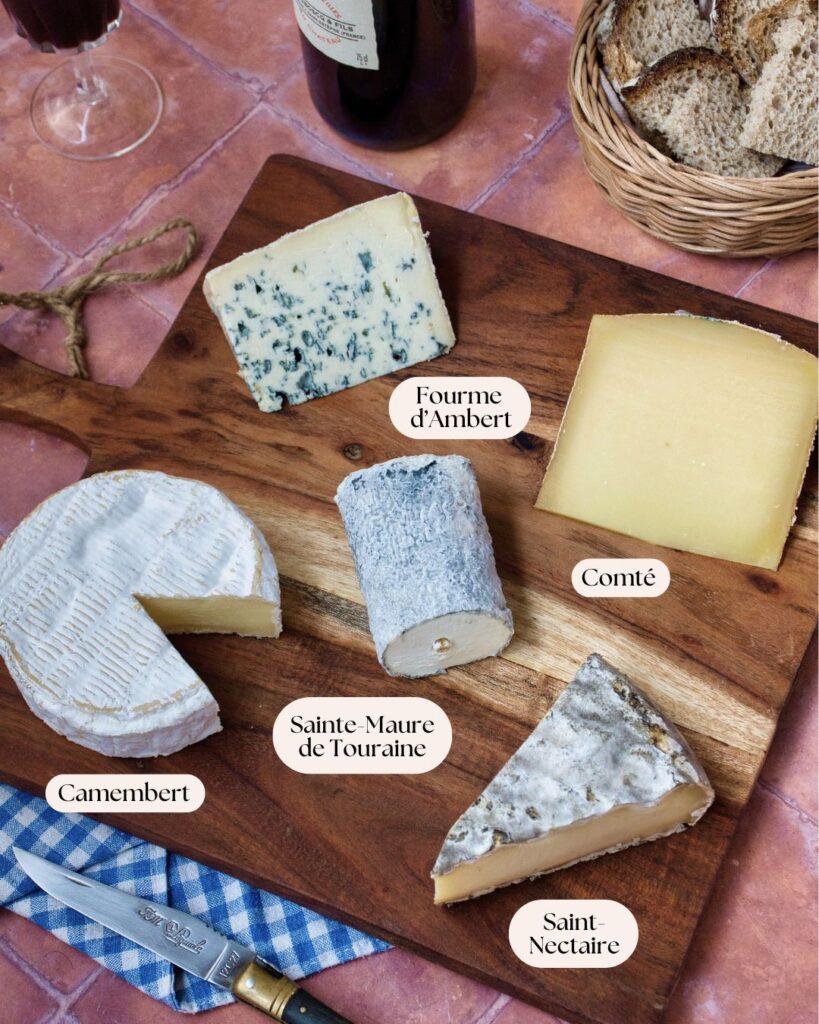
Comté
Comté is one of France’s most popular cheeses, produced in the Jura mountain range of eastern France. This hard, cow’s milk cheese is known for its nutty, complex flavor that develops beautifully with age. Comté can be aged anywhere from 4 months to over 24 months, tasting fruitier and saltier over time. Interestingly, despite the impression of saltiness, Comté is actually very low in salt—only 0.8 g per 100 g, making it one of the least salty cheeses you’ll find.
The color of Comté reflects the seasons because it depends on what the cows eat. In winter, when they are fed mainly hay, the cheese is a pale yellow. In summer, when the cows graze on fresh pasture rich in beta-carotene, the cheese develops a deeper, golden hue.
To truly appreciate its flavor, pair Comté with a white wine from Jura, made from Chardonnay or Savagnin grapes. In cooking, Comté shines in classic French dishes like gougères (a baked savory choux pastry) and savory soufflé (an airy, baked egg dish).
Comté is crafted daily in around 140 cheesemaking workshops called fruitières (a word that comes from “fruit of labor”). These cooperative dairies have existed for over 800 years, dating back to the Middle Ages when several farmers pooled their milk to produce a “cheese for keeping,” requiring the combined output of multiple herds. Each wheel requires over 100 gallons (400 liters) of milk from Montbéliarde or Simmental cows and can weigh around 90 pounds (40 kg)…that’s a huge wheel of cheese! Comté is an AOP cheese (Appellation d’Origine Protégée), which guarantees it is made according to strict regional and quality standards.
During my hiking trip in the Jura mountains, I had the chance to visit Le Fort des Rousses, a historic mountain fortress built under Napoleon that now houses part of the Comté production and aging process. It was fascinating to explore the enormous (and smelly!) aging cellars carved into the rock and learn about the meticulous daily care of each wheel. I also got to taste test Comté aged from 4 to 36 months…YUM!
Saint-Nectaire
Saint-Nectaire is a semi-soft cow’s milk cheese produced on the volcanic peaks of the Auvergne region in central France. Known for its earthy, slightly lactic flavor, it develops a distinctive hazelnut-scented rind as it matures. This cheese is aged for at least four weeks.
There are two types of Saint-Nectaire: fermier and laitier. These varieties are made differently and have distinct tastes and appearances. Without getting into too much detail, Saint-Nectaire laitier is made from milk collected from multiple farms. It is milder, has a slightly orange rind, and is produced on a larger scale. Saint-Nectaire fermier is made directly on a single farm using raw milk from that farm’s own cows. Its flavor is richer and more complex, the rind is often darker, and production is smaller. I recommend the fermier variety.
Each wheel of Saint-Nectaire weighs about 4 lbs (1.7 kg) and requires roughly 3 gallons (12–14 liters) of milk. It comes from one of the smallest AOP zones in Europe, making it a true artisanal specialty. Saint-Nectaire is also steeped in history: fun fact…it was served at the table of Louis XIV!
For pairing, try a white wine from Auvergne, such as Saint-Pourçain. Saint-Nectaire is also delicious in tartiflette and truffade, rustic potato dishes perfect for cozy, comforting meals.
On a personal note, Saint-Nectaire holds a special place in my kitchen because it’s my French boyfriend’s favorite cheese…and I am definitely a convert!
Sainte-Maure de Touraine
Sainte-Maure de Touraine is a delicious goat’s milk cheese from the Loire Valley in western France. Recognizable by its log shape and ash coating, it’s mild and has a slightly tangy and earthy taste. The cheese is aged for at least 10 days, developing a creamy texture that gradually becomes drier and more crumbly as it matures.
One of its most iconic features is the rye straw running through the center. Originally, this straw helped keep the fragile log intact during aging and transport. Today, it is also a guarantee of authenticity: because the cheese was long subject to counterfeiting, each straw is now laser-marked with the AOP name and the identification number of the producer.
Each log weighs about 9 oz (250 g) and requires and half a gallon (2 liters) of milk to make. Its production is relatively small-scale, with just six cheese dairies and one dedicated aging facility.
Sainte-Maure de Touraine has also made its mark in French literary culture. Honoré de Balzac praised it in his 1841 novel La Rabouilleuse. Balzac was from Touraine, and was a true lover of the region and its products. He famously declared that he loved it “like an artist loves art”.
To enjoy it at its best, pair Sainte-Maure de Touraine with a dry Loire white wine such as Sancerre. The contrast of creamy cheese against crunchy baguette is simple perfection. It’s also lovely eaten on its own, with a drizzle of honey or a spoonful of fruit jam, which plays beautifully against the goat cheese’s bright tang.
Camembert
Camembert is a classic cow’s-milk cheese from Normandy in northwestern France. Known for its creamy texture and bloomy white rind, it has a rich, buttery flavor with subtle earthy notes. Aged for at least three weeks, Camembert is sometimes described as Brie’s stronger, more rustic cousin, with a deeper, more pronounced taste.
The legend attributes its creation to Marie Harel, a farmer from the small village of Camembert, during the French Revolution. She is said to have developed the recipe that would make Camembert the most famous and iconic French cheese.
This AOP cheese is molded by hand with a ladle. In total, five ladles are deposited, each at intervals of at least 40 minutes, meaning it takes over three hours to mold a single Camembert! Each wheel weighs about 8 oz (250 g). After about 30 days of aging, the cheese is considered fait à cœur, or perfectly ripened at its center, with fresh milk and forest-floor aromas.
It pairs beautifully with traditional Normandy beverages such as hard cider or Calvados, a local apple brandy. Camembert is also delicious when baked: simply score the rind, add herbs, and bake until soft and gooey for a perfect appetizer and accompaniment to crusty bread.
Fourme d’Ambert
Fourme d’Ambert is a soft blue cow’s-milk cheese from the Monts du Forez in central France. Known for its creamy texture and characteristic blue veining, it is the mildest of French blue cheeses. Think of it as Roquefort’s gentle, approachable cousin. There’s really no comparison with the sharp, tangy, and often salty blue cheeses commonly made in the U.S…so give it a try, even if you usually shy away from blue cheese.
Full disclosure: I don’t like any form of blue cheese. But Fourme d’Ambert is one of my boyfriend’s three favorite cheeses, and I promised him I would include it so you won’t be deprived of some blue cheese education! When we finally bought it for the purposes of this article, he said he felt “liberated” and “so happy” to have it at home…who knew!
Fourme d’Ambert is made from cow’s milk from herds grazing at over 1,970 ft (600 meters), the minimum altitude required to meet the AOP designation. The milk is transformed into thousands of small curd pieces, a long and meticulous process that gives the cheese its texture. It’s aged for at least one month, and each wheel typically weighs about 2 lbs (1 kg).
This cheese pairs beautifully with sweet or dessert white wines and works wonderfully in gratin dishes, risottos, or served simply with walnuts to highlight its nutty undertones.
Comte is definitely one of my favourites!
Got to look into that ‘fourme’…
Me too–I love comté!