
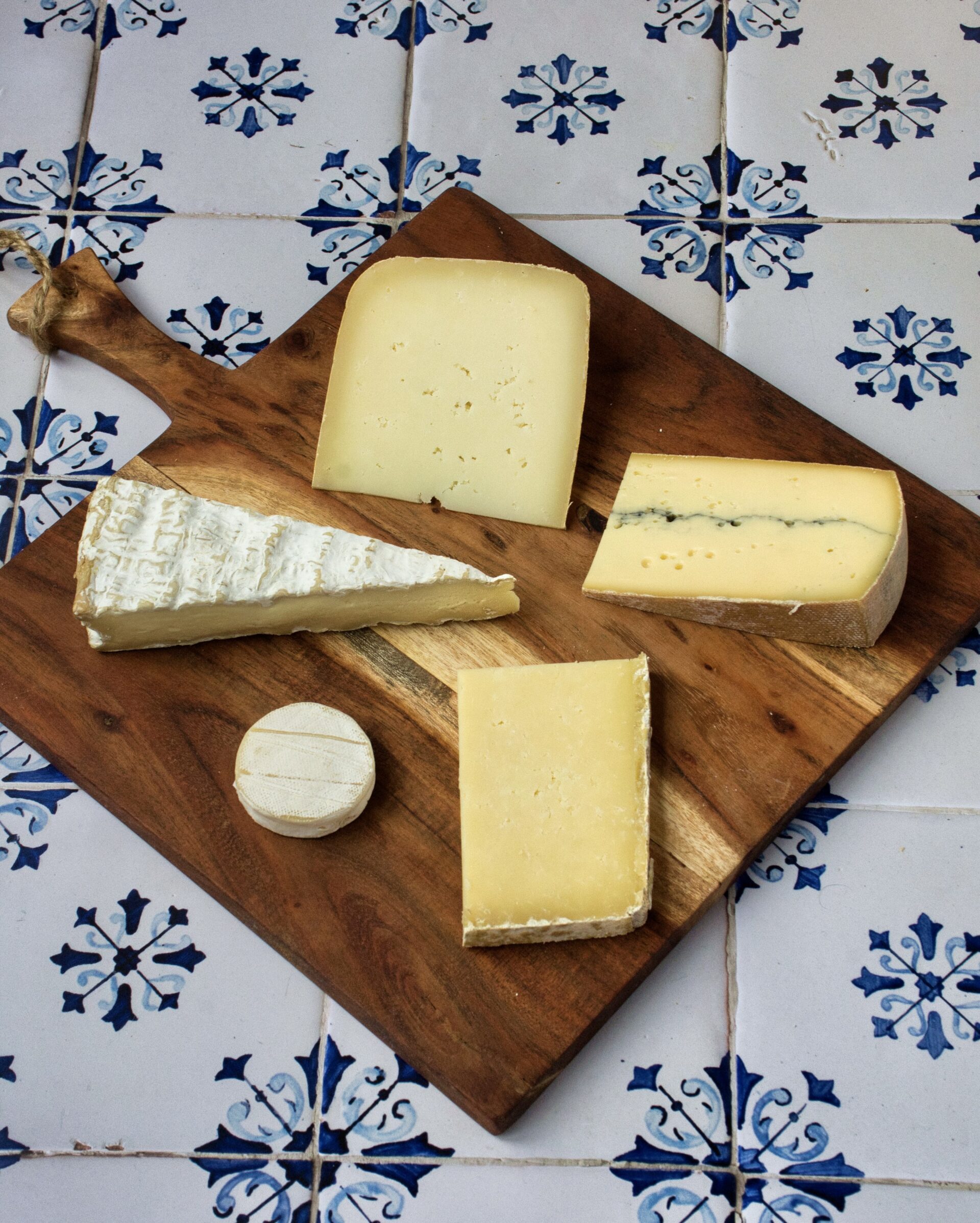
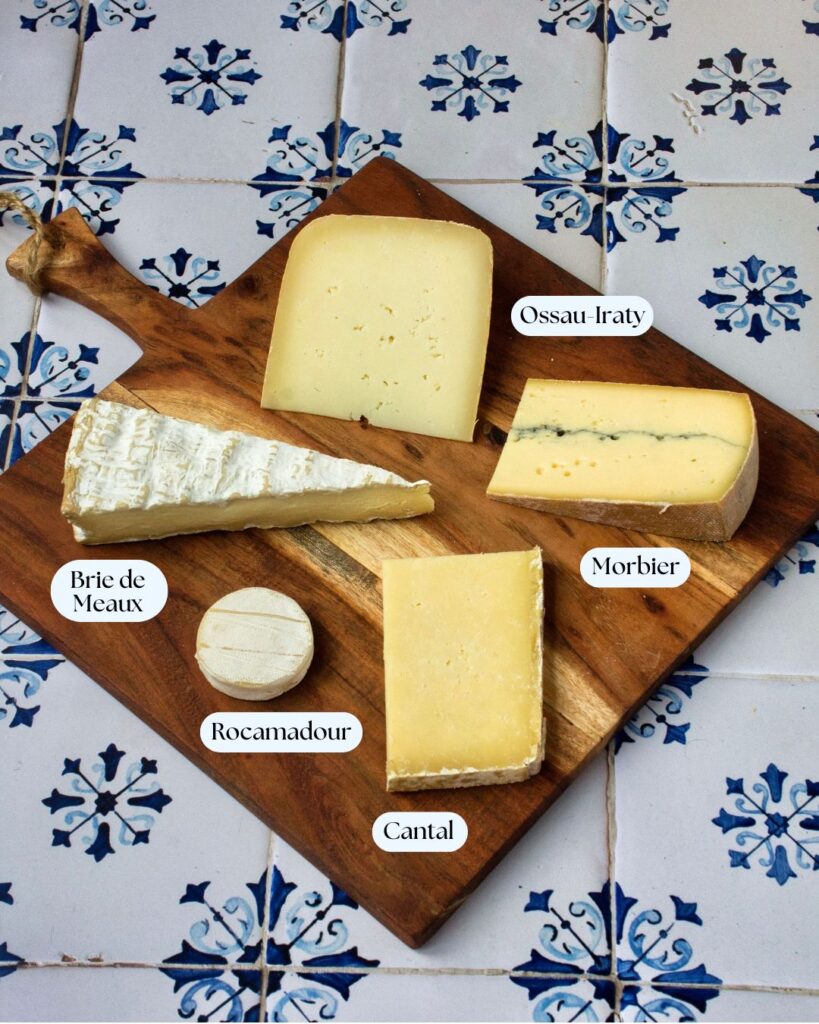
Ossau-Iraty, Cantal, Brie de Meaux, Morbier, and Rocamadour—five beloved and traditional French cheeses. In this guide, you’ll discover their origins, flavor profiles, ideal drink pairings, and ways to cook with them. Perfect if you’re looking to elevate your cheese board game, learn more about French cheese culture, or prepare your next trip to a fromagerie.
If you’ve missed it, I’m slowly but surely eating my way through France. Naturally, this means visiting plenty of fromageries (cheese shops). And now, thanks to my Ultimate Guide to French Cheese series, I’m taking you with me on this delicious journey, one cheese at a time! If you haven’t already, check out my first Essential French Cheeses article.
Grab a snack (preferably some cheese), and let’s chat!
Here are the cheeses I’ll be talking about today:
Ossau-Iraty
Ossau-Iraty is a semi-firm, sheep’s milk cheese from the Pyrénées-Atlantiques area of southwestern France. Its name reflects the land that shapes it: the Ossau Valley in the Béarn Country, and the Iraty mountains in the Basque Country (two neighboring zones). Farmers have been raising livestock in this area for over 7,000 years!
It’s a pressed cheese that holds AOP status (Appellation d’Origine Protégée), ensuring strict adherence to traditional methods and quality standards. The Béarn type has rounded edges, is moister, and melts beautifully on the tongue. The Basque type has right-angled edges and a firmer, drier, slightly crumbly texture. Its flavor is mellow, nutty, and slightly fruity. It’s a very approachable cheese!
Like many French cheeses, Ossau-Iraty comes in fermier and laitier versions: the fermier cheeses (made directly on the farm with milk from a single flock) offer deeper, more complex aromas, while the laitier versions (made in a cheese factory with milk from multiple farms) tend to be more uniform and mild in taste.
A unique feature of Ossau-Iraty is the etched logo on its rind, which identifies how it was produced. There are three logos: one for laitier production, one for fermier production, and a third used only for cheeses made when the sheep graze at high altitude (shepherds move their sheep to higher mountain pastures in the summer to graze on lush grasses and wildflowers, leading to a more complex taste).
A fun historical detail: back in the 14th century, Ossau-Iraty was so valued that it was used as a form of currency to pay taxes, bills, and leases. It represented one of the main sources of income for shepherds.
Ossau-Iraty is traditionally enjoyed with black cherry jam. For the perfect wine paring, try a dry Jurançon white wine produced in the Pyrénées, near where Ossau-Iraty is made.
Cantal
Cantal is one of France’s oldest cheeses, with a history stretching back over 2,000 years to the Gaulish period. This firm cheese is made in south-central France in a volcanic area of the Auvergne region.
Cantal is a pressed cow’s milk cheese protected under AOP status. Like Ossau-Iraty, Cantal exists in fermier and laitier versions. A whole wheel weighs around 90 lbs (40 kg)! Its distinct texture comes from a unique production process: The curds are pressed a first time, creating a large slab called a tomme. The tomme is broken up in a mill, before being salted and pressed again to form the final wheel shape. The intermediate form of Cantal (tomme) is a key ingredient in beloved regional dishes like aligot and truffade, made with potatoes and melted cheese.
Cantal comes in three aging stages, each distinctly flavored. Jeune (1–2 months) is mild, milky, and tender. Entre-deux (3–7 months) gains complexity with more pronounced aromas. And vieux (aged more than 8 months) is bold, peppery, and slightly crumbly. As the cheese ages, its color changes from pale to dark yellow.
For a classic pairing, try a Côtes d’Auvergne wine, produced in the same region as Cantal. For younger Cantals, a white Côtes d’Auvergne is best; for older Cantals, a light red Côtes d’Auvergne made from Gamay grapes is also delicious.
Brie de Meaux
In my opinion, Brie de Meaux is the queen of Bries. This AOP cow’s milk cheese is made just east of Paris in the Seine-et-Marne area. It’s soft, creamy, and covered with a signature (edible) bloomy rind. Its flavor is beautifully balanced: buttery and nutty when young, growing more intense and earthy as it matures.
This cheese has deep historical roots. Louis XIV loved Brie de Meaux so much that it was delivered weekly to Versailles. Today, it’s still crafted similarly to centuries ago: the curds are hand-ladled using a special tool called a “brie shovel,” then salted, molded, and aged in cellars for 4–8 weeks.
Brie de Meaux is delicious paired with black truffle and apples, or baked with fresh herbs. It’s featured in regional specialties like galette briarde (a crumbly shortbread made with Brie) or the croque-briard (a Brie-filled croque-monsieur aka ham and cheese sandwich).
What should you drink with this indulgent cheese? Sparkling options like Champagne are perfect for cutting through the richness of Brie de Meaux. A dry, crisp Sauvignon Blanc or Chablis also pair beautifully.
Morbier
Morbier is instantly recognizable thanks to the thin, dark line running through its center. This semi-soft, pressed cow’s milk cheese is made in the Jura mountains in Eastern France. At the end of the 18th century, harsh winter conditions sometimes kept farmers from delivering their milk to the cooperative for Comté cheese production. Instead, they made their own cheese at home: they would press the evening curds into a mold and cover them with ash to protect them overnight, then add the morning curds on top. Today, the line is made with edible vegetal charcoal — a tribute to this resourceful tradition.
With AOP status, Morbier is matured for at least 45 days and offers a mild, milky, slightly fruity flavor that I absolutely adore. It’s wonderful on a cheese board but also melts spectacularly, making it a great choice for raclette if you want to try something different from the usual cheeses.
For pairing: Younger Morbiers are great with crisp, white wines from the Jura region, like Arbois or Côtes du Jura. More mature Morbiers are beautifully complemented by the famous Jura vin jaune (yellow wine). This dry white wine is made from Savagnin grapes and aged for over six years under a protective veil of yeast. It has powerful, complex aromas (think hazelnut, honey, apple, warm spices).
Rocamadour
Rocamadour is a delicate goat cheese from Périgord and Quercy in southwestern France. This AOP cheese is made with goat’s milk and is part of the “cabécou” family (meaning “little goat” in the Occitan regional language). It melts in your mouth and has a thin rind that’s meant to be eaten. Rocamadour typically ages for about two weeks, though longer aging is possible and brings stronger notes.
Rocamadour is sold as a small, thin round, about the size of the palm of your hand. Each round is labeled with a tag guaranteeing its authenticity.
These little cheeses are wonderful spread on toasted bread, tossed into salads, or paired with apples and walnuts. Their mild creaminess works especially well with light, dry white wines from southwestern France. Think Bergerac, made from Sauvignon Blanc, Sémillon, or Muscadelle. If you’re unfamiliar with this wine, it’s often compared to fresh white Bordeaux.